Enhancing SOF Mission Success Through Persistent, Passive Airspace Awareness
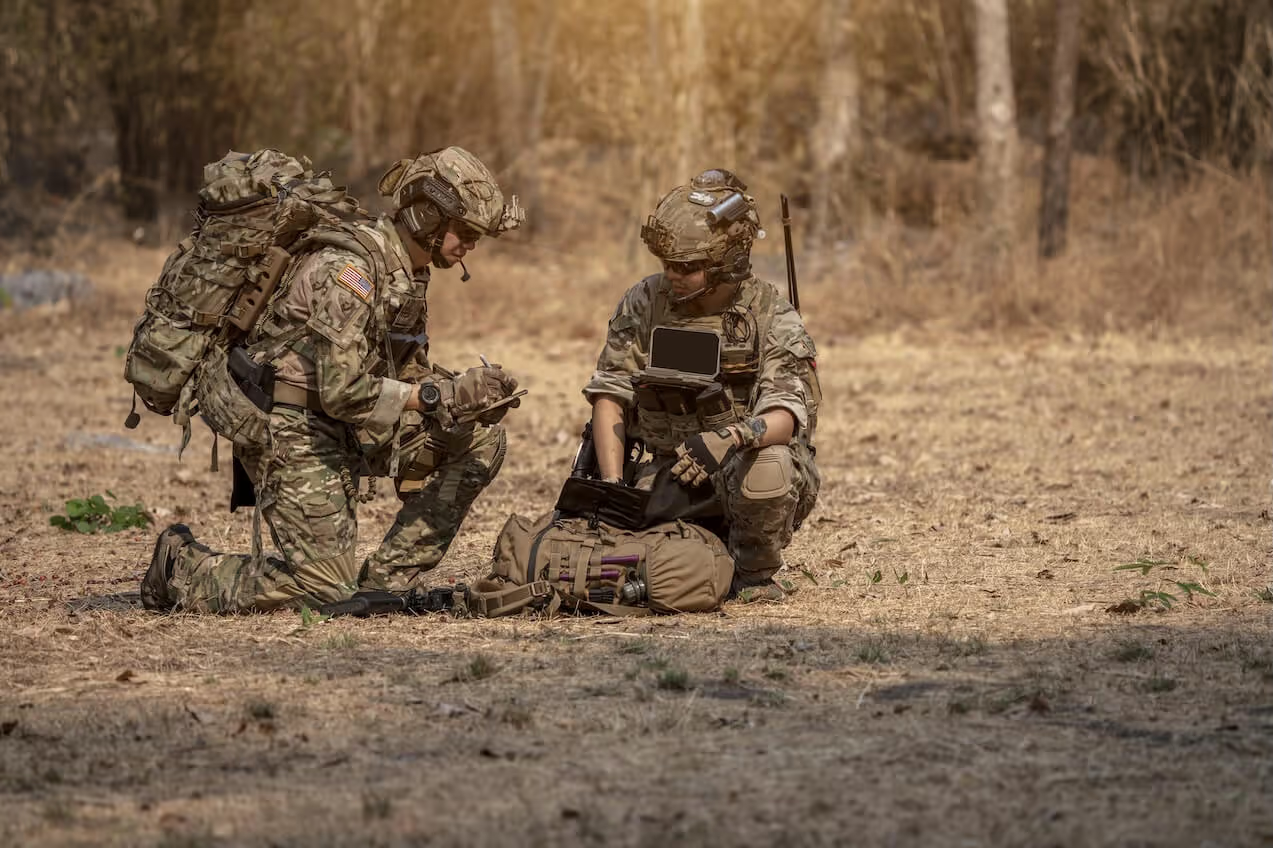


In today’s operational environment, the airspace is no longer permissive—it is a contested layer of the battlespace. For Special Operations Forces (SOF), this challenge is most acute at the tactical edge, where small, low-cost unmanned systems operate at short range and low altitude.
These threats are pervasive, difficult to detect, and easy for adversaries to deploy. More importantly, they expand the ability to observe, track, and target—often with only brief or intermittent warning, particularly in complex terrain or urban environments.
Maintaining awareness of the airspace is no longer optional. It is foundational to preserving freedom of maneuver and decision advantage.
The Limits of Traditional Detection in SOF Environments
SOF teams operate with constraints that limit the effectiveness of conventional counter-UAS approaches. Mobility, low signature requirements, and limited power all shape what is practical in the field.
Active sensing systems can provide value, particularly for fixed positions or larger elements, but they introduce tradeoffs at the small-unit level:
- Emissions that risk exposing position
- Power and sustainment demands that reduce endurance
- Line-of-sight and terrain dependencies that create coverage gaps
In contested or degraded environments, these limitations reduce reliability—especially against low-signature, rapidly deployed threats.
Passive Sensing for Distributed, Persistent Awareness
Passive sensing aligns with how SOF operates: distributed, low-signature, and adaptive.
Hidden Level delivers this capability through passive systems that detect and analyze emissions associated with UAS operation, such as command-and-control links and video downlinks, providing continuous airspace awareness without transmitting energy. This enables persistent sensing where RF activity is present, while preserving electromagnetic discipline.
Built for rapid integration, Hidden Level systems use open APIs and modular data formats to work within existing C2 and situational awareness tools such as ATAK at the tactical edge and FAAD C2 at higher echelons. Detections and tracks are immediately available within the platforms operators already use—without adding interfaces or cognitive burden.
Deployed as a primary detection layer within U.S. Army programs of record, this technology is proven in operational environments and built to scale across formations.
This approach enables:
- Early detection of UAS activity
- Continuous tracking in complex or cluttered terrain
- Scalable deployment across distributed elements
The result is a resilient sensing layer that extends awareness across the force.
Passive RF sensing is not always a standalone solution and is strongest when integrated into a layered approach—adding awareness in scenarios where emitting systems are constrained or where additional context is needed.
Enabling Decision Advantage at the Tactical Edge
Detection alone does not improve outcomes—it must drive action.
When integrated into C2 and ISR architectures, passive RF sensing contributes to a more complete operational picture. Data becomes context, helping operators distinguish between isolated activity and persistent presence, and enabling faster, more informed decisions.
Hidden Level enables this by delivering RF-derived data in interoperable formats that fuse with existing sensor inputs. Instead of isolated alerts, teams gain insight into patterns, potential operator behavior, and timing within the electromagnetic environment.
This supports:
- Faster threat assessment and response prioritization
- More informed maneuver decisions
- Improved coordination across distributed units through shared awareness
In time-constrained, low-visibility environments, this shift—from detection to decision advantage—is critical.
Strengthening Force Protection Without Compromise
For SOF, force protection must coexist with speed, agility, and stealth.
Persistent passive airspace awareness supports this balance. It can provide earlier warning and continuous insight without increasing electromagnetic signature or operational burden.
Because it integrates into systems operators already use, it enhances survivability without adding complexity. Teams remain focused on execution—not managing additional tools.
Operating with Confidence in the Invisible Battlespace
The modern battlespace is increasingly defined by what cannot be seen. Signals, emissions, and activity patterns now shape both risk and opportunity.
Hidden Level systems help bring this invisible layer into focus—enabling forces to sense, understand, and act without compromising how they operate.
For SOF at the tactical edge, integrating persistent, passive airspace awareness into distributed C2 and ISR networks is not just an enhancement—it is a scalable, interoperable approach to improving awareness and maintaining decision advantage in contested environments
.avif)
%20(1).avif)